最近悟出來一個道理,在這兒分享給大家:學歷代表你的過去,能力代表你的現在,學習代表你的將來。
十年河東十年河西,莫欺少年窮
學無止境,精益求精
本節探討C#獲取漢字拼音首字母的方法:
代碼類東西,直接上代碼:
        /// <summary>

        /// 在指定的字符串列表CnStr中檢索符合拼音索引字符串

        /// </summary>

        /// <param name="CnStr">漢字字符串</param>

        /// <returns>相對應的漢語拼音首字母串</returns>

        public static string GetSpellCode(string CnStr)
        {

            string strTemp = "";

            int iLen = CnStr.Length;

            int i = 0;

            for (i = 0; i <= iLen - 1; i++)
            {

                strTemp += GetCharSpellCode(CnStr.Substring(i, 1));
                break;
            }

            return strTemp;

        }

        /// <summary>

        /// 得到一個漢字的拼音第一個字母,如果是一個英文字母則直接返回大寫字母

        /// </summary>

        /// <param name="CnChar">單個漢字</param>

        /// <returns>單個大寫字母</returns>

        private static string GetCharSpellCode(string CnChar)
        {

            long iCnChar;

            byte[] ZW = System.Text.Encoding.Default.GetBytes(CnChar);

            //如果是字母,則直接返回首字母

            if (ZW.Length == 1)
            {

                return CommonMethod.CutString(CnChar.ToUpper(),1);

            }
            else
            {

                // get the array of byte from the single char

                int i1 = (short)(ZW[0]);

                int i2 = (short)(ZW[1]);

                iCnChar = i1 * 256 + i2;

            }

            // iCnChar match the constant

            if ((iCnChar >= 45217) && (iCnChar <= 45252))
            {

                return "A";

            }

            else if ((iCnChar >= 45253) && (iCnChar <= 45760))
            {

                return "B";

            }
            else if ((iCnChar >= 45761) && (iCnChar <= 46317))
            {

                return "C";

            }
            else if ((iCnChar >= 46318) && (iCnChar <= 46825))
            {

                return "D";

            }
            else if ((iCnChar >= 46826) && (iCnChar <= 47009))
            {

                return "E";

            }
            else if ((iCnChar >= 47010) && (iCnChar <= 47296))
            {

                return "F";

            }
            else if ((iCnChar >= 47297) && (iCnChar <= 47613))
            {

                return "G";

            }
            else if ((iCnChar >= 47614) && (iCnChar <= 48118))
            {

                return "H";

            }
            else if ((iCnChar >= 48119) && (iCnChar <= 49061))
            {

                return "J";

            }
            else if ((iCnChar >= 49062) && (iCnChar <= 49323))
            {

                return "K";

            }
            else if ((iCnChar >= 49324) && (iCnChar <= 49895))
            {

                return "L";

            }
            else if ((iCnChar >= 49896) && (iCnChar <= 50370))
            {

                return "M";

            }
            else if ((iCnChar >= 50371) && (iCnChar <= 50613))
            {

                return "N";

            }
            else if ((iCnChar >= 50614) && (iCnChar <= 50621))
            {

                return "O";

            }
            else if ((iCnChar >= 50622) && (iCnChar <= 50905))
            {

                return "P";

            }
            else if ((iCnChar >= 50906) && (iCnChar <= 51386))
            {

                return "Q";

            }
            else if ((iCnChar >= 51387) && (iCnChar <= 51445))
            {

                return "R";

            }
            else if ((iCnChar >= 51446) && (iCnChar <= 52217))
            {

                return "S";

            }
            else if ((iCnChar >= 52218) && (iCnChar <= 52697))
            {

                return "T";

            }
            else if ((iCnChar >= 52698) && (iCnChar <= 52979))
            {

                return "W";

            }
            else if ((iCnChar >= 52980) && (iCnChar <= 53640))
            {

                return "X";

            }
            else if ((iCnChar >= 53689) && (iCnChar <= 54480))
            {

                return "Y";

            }
            else if ((iCnChar >= 54481) && (iCnChar <= 55289))
            {

                return "Z";

            }
            else

                return ("?");

        }
截取字符串的方法:
#region 截取字符長度 static string CutString(string str, int len)
        /// <summary>
        /// 截取字符長度
        /// </summary>
        /// <param name="str">被截取的字符串</param>
        /// <param name="len">所截取的長度</param>
        /// <returns>子字符串</returns>
        public static string CutString(string str, int len)
        {
            if (str == null || str.Length == 0 || len <= 0)
            {
                return string.Empty;
            }

            int l = str.Length;


            #region 計算長度
            int clen = 0;
            while (clen < len && clen < l)
            {
                //每遇到一個中文,則將目標長度減一。
                if ((int)str[clen] > 128) { len--; }
                clen++;
            }
            #endregion

            if (clen < l)
            {
                return str.Substring(0, clen) + "...";
            }
            else
            {
                return str;
            }
        }

        /// <summary>
        /// //截取字符串中文 字母
        /// </summary>
        /// <param name="content">源字符串</param>
        /// <param name="length">截取長度!</param>
        /// <returns></returns>
        public static string SubTrueString(object content, int length)
        {
            string strContent = NoHTML(content.ToString());

            bool isConvert = false;
            int splitLength = 0;
            int currLength = 0;
            int code = 0;
            int chfrom = Convert.ToInt32("4e00", 16);    //范圍(0x4e00~0x9fff)轉換成int(chfrom~chend)
            int chend = Convert.ToInt32("9fff", 16);
            for (int i = 0; i < strContent.Length; i++)
            {
                code = Char.ConvertToUtf32(strContent, i);
                if (code >= chfrom && code <= chend)
                {
                    currLength += 2; //中文
                }
                else
                {
                    currLength += 1;//非中文
                }
                splitLength = i + 1;
                if (currLength >= length)
                {
                    isConvert = true;
                    break;
                }
            }
            if (isConvert)
            {
                return strContent.Substring(0, splitLength);
            }
            else
            {
                return strContent;
            }
        }

        public static int GetStringLenth(object content)
        {
            string strContent = NoHTML(content.ToString());
            int currLength = 0;
            int code = 0;
            int chfrom = Convert.ToInt32("4e00", 16);    //范圍(0x4e00~0x9fff)轉換成int(chfrom~chend)
            int chend = Convert.ToInt32("9fff", 16);
            for (int i = 0; i < strContent.Length; i++)
            {
                code = Char.ConvertToUtf32(strContent, i);
                if (code >= chfrom && code <= chend)
                {
                    currLength += 2; //中文
                }
                else
                {
                    currLength += 1;//非中文
                }

            }
            return currLength;
        }
        #endregion
以上便是完整代碼,謝謝!
在此,順便說下數據庫按照漢字首字母進行排序的方法:
oracle :
在oracle9i中新增了按照拼音、部首、筆畫排序功能。設置NLS_SORT值
SCHINESE_RADICAL_M 按照部首(第一順序)、筆劃(第二順序)排序
SCHINESE_STROKE_M 按照筆劃(第一順序)、部首(第二順序)排序
SCHINESE_PINYIN_M 按照拼音排序,系統的默認排序方式為拼音排序
舉例如下:
表名為 dept ,其中name字段是中文,下面分別實現按照單位名稱的筆劃、部首和拼音排序。
//按照筆劃排序
select * from dept order by nlssort(name,'NLS_SORT=SCHINESE_STROKE_M');
//按照部首排序
select * from dept order by nlssort(name,'NLS_SORT=SCHINESE_RADICAL_M');
//按照拼音排序,此為系統的默認排序方式
select * from dept order by nlssort(name,'NLS_SORT=SCHINESE_PINYIN_M');
sqlserver
select * from table order by name collate Chinese_PRC_CS_AS_KS_WS

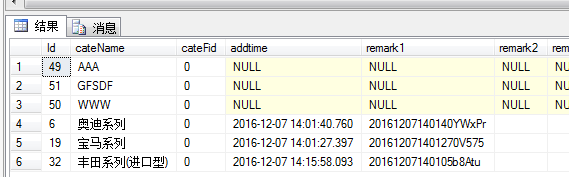
執行結果:select * from Table where cateFid=0 order by cateName collate Chinese_PRC_CS_AS_KS_WS
@陳臥龍的博客