迭代器也是C# 2.0的產物。
1.1 迭代器的簡介
迭代器記錄了集合中的某個位置,它使程序只能向前移動。C# 1.0中使用foreach語句來實現訪問迭代器的內置支持,foreach使遍歷集合變得簡單,它比for語句更方便,也更容易理解。foreach被編譯器編譯後,會調用GetEnumerator來返回一個迭代器,也就是一個集合中的初始位置。
1.2 C# 1.0中如何實現迭代器
一個類型想要使用foreach關鍵字進行遍歷,它必須實現IEnumerable或IEnumerable<T>接口。IEnumerable接口中定義了一個GetEnumerator方法用來返回迭代器,類型如果實現了IEnumerable接口,則也必須實現GetEnumerator方法。
 1 namespace 迭代器
 2 {
 3     class Program
 4     {
 5         static void Main(string[] args)
 6         {
 7             Friends friendcollection=new Friends();
 8             foreach (Friend friend in friendcollection)
 9             {
10                 Console.WriteLine(friend.Name);
11             }
12             Console.ReadKey();
13         }
14     }
15
16     public class Friend
17     {
18         private string name;
19         public string Name
20         {
21             get { return name; }
22             set { name = value; }
23         }
24
25         public Friend(string name)
26         {
27             this.name = name;
28         }
29     }
30
31     public class Friends : IEnumerable
32     {
33         private Friend[] friendarray;
34
35         public Friends()
36         {
37             friendarray=new Friend[]
38             {
39                 new Friend("張三"),
40                 new Friend("李四"),
41                 new Friend("王五"),
42             };
43         }
44
45         //索引器
46         public Friend this[int index] => friendarray[index];
47
48         public int Count => friendarray.Length;
49
50         //實現IEnumerable<T>接口的方法
51         public IEnumerator GetEnumerator()
52         {
53             return new FriendIterator(this);
54         }
55     }
56
57     public class FriendIterator : IEnumerator
58     {
59         private readonly Friends friends;
60         private int index;
61         private Friend current;
62         internal FriendIterator(Friends friendcollection)
63         {
64             this.friends = friendcollection;
65             index = 0;
66         }
67
68         public bool MoveNext()
69         {
70             if (index + 1 > friends.Count)
71             {
72                 return false;
73             }
74             else
75             {
76                 this.current = friends[index];
77                 index++;
78                 return true;
79             }
80         }
81
82         public void Reset()
83         {
84             index = 0;
85         }
86         //實現IEnumerator接口中的方法
87         public object Current => this.current;
88
89     }
90 }
從以上的代碼可以看出,在C# 1.0中,要使用某個類型可以迭代是需要寫大量代碼的。
1.3 C# 2.0簡化了迭代器的實現
不說這麼多,直接上代碼:
 1 namespace 迭代器
 2 {
 3     class Program
 4     {
 5         static void Main(string[] args)
 6         {
 7             Friends friendcollection=new Friends();
 8             foreach (Friend friend in friendcollection)
 9             {
10                 Console.WriteLine(friend.Name);
11             }
12             Console.ReadKey();
13         }
14     }
15
16     public class Friend
17     {
18         private string name;
19         public string Name
20         {
21             get { return name; }
22             set { name = value; }
23         }
24
25         public Friend(string name)
26         {
27             this.name = name;
28         }
29     }
30
31     public class Friends : IEnumerable
32     {
33         private Friend[] friendarray;
34
35         public Friends()
36         {
37             friendarray=new Friend[]
38             {
39                 new Friend("張三"),
40                 new Friend("李四"),
41                 new Friend("王五"),
42             };
43         }
44
45         //索引器
46         public Friend this[int index] => friendarray[index];
47
48         public int Count => friendarray.Length;
49
50         //實現IEnumerable<T>接口的方法
51         public IEnumerator GetEnumerator()
52         {
53             for (int index = 0; index < friendarray.Length; index++)
54             {
55                 //在C# 2.0中,只需要使用下面的語句就可以實現一個迭代器
56                 yield return friendarray[index];
57             }
58         }
59     }
60 }
這段代碼只用了一個yield return就完成了迭代器的實現,它作用就是在告訴編譯器,GetEnumerator方法不是一個普通的方法,而是實現迭代器的方法。當編譯器看到yield return 語句時,會在中間代碼中為我們生成了一個IEnumerator接口的對象。可以使用反射工具Reflector看一下。
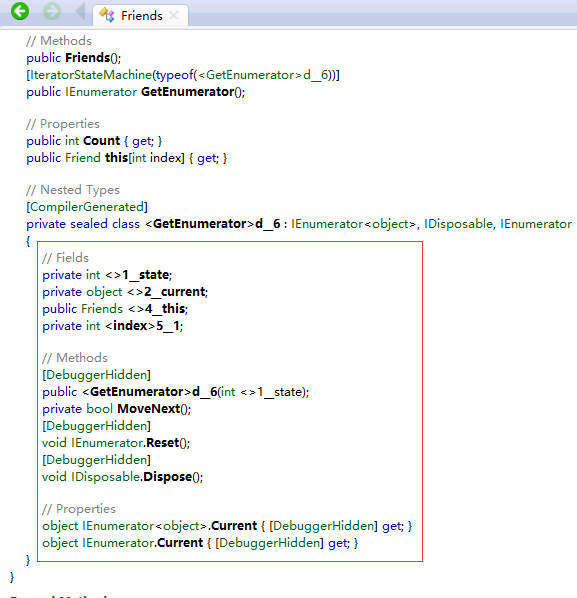
由上圖可以看出,yield return語句其實是C#中提供的另一個語法糖(語法糖可以理解為C#提供的一種方便形式),它簡化了我們的迭代器源代碼,把具體而復雜的實現過程留給了編譯器去完成。