散列表,英文叫做Hash Table,因此也叫哈希表,是一種根據關鍵字值來確定主存中存儲位置的數據結構.通過一個散列函數(關於鍵值的函數),來確定存儲該關鍵字的位置.
主要的方法有: 1.分離鏈接法(拉鏈法)
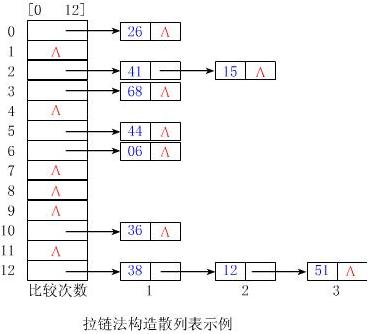
分離鏈接法的散列函數為 position = key % n. 即關鍵字的存儲位置為關鍵字的值對表項的數量取模.若表項大小為13,對於關鍵值為27的項,存儲在1(27 % 13 = 1)的表項處.為了減少沖突,n往往取素數.對於同余的關鍵字,采用 隊列(鏈表) 的方式連接在一起,新放入的元素放入隊頭或者隊尾均可.用圖描述如下:
2.線性探查法
線性探查法是根據沖突次數,來從目標位置後移沖突次數次位置來避免沖突的,即position_new = (position + i) % n,其中i為沖突次數,n為表項大小.
3.平方探查法
與線性探查法類似,只不過是散列函數的不同,其position_new = (position + i2 ) % n
4. 雙散列,再散列等
分離鏈接法的數據結構的數據結構的構造,使用一個名為HashTable的類來封裝整個表的操作和屬性.用vector<deque<int>>來表示整個數據結構,即整個表是一個由(雙端)
隊列組成的向量(數組).類中還包含其他的函數,用來訪問類中的私有屬性.
類的聲明如下:
 1 class HashTable {
 2     public:
 3         HashTable(int = 11);
 4         ~HashTable() = default;
 5         int getHashItemSize(const int) const;        //獲得隊列長度
 6         int getHashTableSize() const;        //獲得表項的大小
 7         bool insertRecord(int);        //插入一個值
 8         void removeRecord(const int);            //刪除一個值
 9         bool isEmpty() const;       //判斷哈希表是否為空
10         void print() const;       //打印哈希表
11
12     private:
13         vector<deque<int>>  HashItem;    //結構定義
14         int HashTableSize = 0;      //哈希表表項數
15 };
構造函數定義:
 1 HashTable::HashTable(int n)     //構造函數定義
 2 {
 3     HashTableSize = n;
 4
 5     for (int i = 0; i < n; ++i)
 6     {
 7         deque<int> adeque;
 8         HashItem.push_back(adeque);     //向向量中壓入足夠的空隊列
 9     }
10 }
插入記錄的函數的定義:
 1 bool HashTable::insertRecord(int data)      //插入一個指定值的記錄
 2 {
 3     int position = data % HashTableSize;                //映射規則
 4
 5     if (position >= HashTableSize || position < 0)    //合法性判斷
 6         return false;
 7
 8     else
 9     {
10         HashItem.at(position).push_front(data);  //根據時間局部性原理,插入到隊頭
11         return true;
12     }
13 }
刪除記錄的函數定義
 1 void HashTable::removeRecord(const int aim)     //刪除一個指定值的記錄
 2 {
 3     int i = 0;
 4     int j = 0;
 5
 6     for (; i < HashTableSize; ++i)            //遍歷表項
 7     {
 8
 9         for (j = 0; j < static_cast<int>(HashItem.at(i).size()); ++j)                //遍歷隊列
10         {
11             if (HashItem.at(i).at(j) == aim)
12                 HashItem.at(i).erase(HashItem.at(i).begin() + j);       //刪除記錄
13         }
14     }
15
16 }
打印函數:
 1 void HashTable::print() const
 2 {
 3     for (int i = 0; i < getHashTableSize(); ++i)        //遍歷表項
 4     {
 5         deque<int> temp = HashItem.at(i);
 6
 7         for (auto &j : temp)            //遍歷隊列
 8             cout << j << ' ';
 9
10         cout << endl;
11     }
12 }
對於主函數,寫了一點測試語句來進行測試:
 1 int main()
 2 {
 3     HashTable hashtable(13);
 4
 5     for (int i = 0; i < 100; ++i)
 6         hashtable.insertRecord(i);
 7
 8     hashtable.print();
 9
10     cout << endl;
11
12     hashtable.removeRecord(91);
13     hashtable.removeRecord(70);
14
15     hashtable.print();
16
17     return 0;
18 }
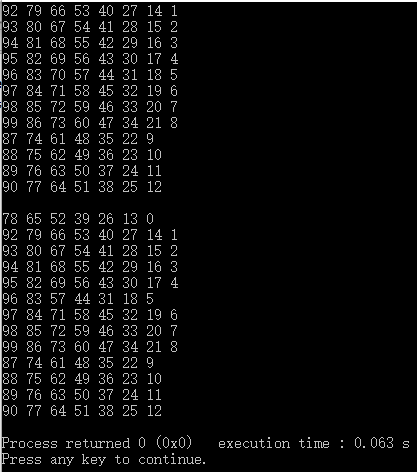
插入0到99的關鍵字,散列到表項大小為13的散列表中,在刪除91和70兩個關鍵值.
運行結果輸出了0到99的散列情況和刪除操作之後的散列情況:
本人原創,轉載請注明出處,謝謝合作!