Generate Parentheses
Given n pairs of parentheses, write a function to generate all combinations of well-formed parentheses.
For example, given n = 3, a solution set is:
((())), (()()), (())(), ()(()), ()()()
分析:
生成合法的括號串。
遞歸:
每次先判斷當前串中的左括號數目是否大於等於右括號數目,如果成立,那麼向當前子串中添加左括號或者右括號。
Python代碼:
class Solution(object):
    def generateParenthesis(self, n):

        :type n: int
        :rtype: List[str]

        res = []
        self.dfs('', n, res)
        return res

    def dfs(self, cur_s, n, res):
        if len(cur_s) == 2 * n:
            res.append(cur_s)
            return
        l_n, r_n = cur_s.count('('), cur_s.count(')')
        if l_n >= r_n:
            if l_n < n:
                self.dfs(cur_s + '(', n, res)
            if r_n < n:
                self.dfs(cur_s + ')', n, res)
class Solution {
public:
    vector generateParenthesis(int n) {
        vector res;
        dfs(, 0, 0, n, res);
        return res;
    }
    void dfs(string cur_s, int l, int r, int n, vector & res){
        if(cur_s.length() == 2 * n){
            res.push_back(cur_s);
            return;
        }
        if(l >= r){
            if(l < n){
                dfs(cur_s + '(', l+1, r, n, res);
            }
            if(r < n){
                dfs(cur_s + ')', l, r+1, n, res);
            }
        }
    }
};
別人家的代碼:
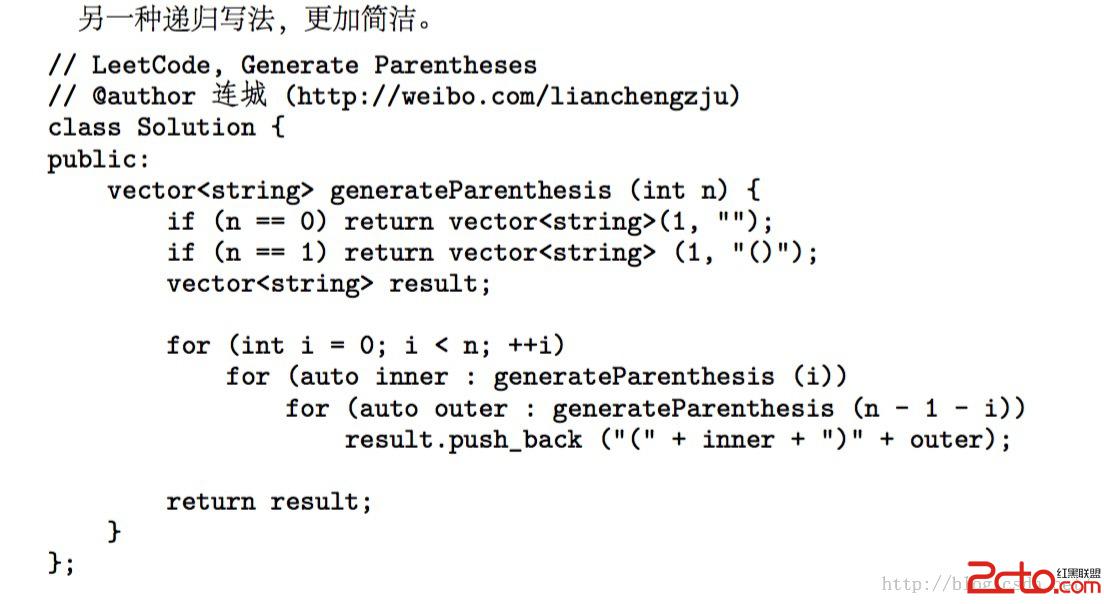
Discuss中看到的動態規劃:
To generate all n-pair parentheses, we can do the following:
Generate 0 pair inside, n - 1 afterward: () (...)...
Generate 1 pair inside, n - 2 afterward: (()) (...)...
...
Generate n - 1 pair inside, 0 afterward: ((...))
I bet you see the overlapping subproblems here. Here is the code:
(you could see in the code that x represents one j-pair solution and y represents one (i - j - 1) pair solution, and we are taking into account all possible of combinations of them)
class Solution(object):
    def generateParenthesis(self, n):

        :type n: int
        :rtype: List[str]

        dp = [[] for i in range(n + 1)]
        dp[0].append('')
        for i in range(n + 1):
            for j in range(i):
                dp[i] += ['(' + x + ')' + y for x in dp[j] for y in dp[i - j - 1]]
        return dp[n]