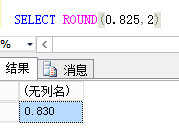
首先問一下round(0.825,2) 返回的結果,大家猜一猜,
首先SQL server 返回的是 0.83
js的返回結果 是0.83,code 如下:
var b = 0.825; alert(Math.round(b * 100) / 100); 其實js中可以 直接用toFixed函數的,
var b = 0.825; alert(b.toFixed(2));
這樣也返回0.83
可是C# 返回的是0.82
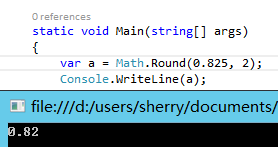
這裡並不是我們期望的0.83, 為什麼了? 其實C#中的Math.Round()並不是使用的"四捨五入"法 而是四捨六入五取偶(銀行家算法),若需要捨入到的位的後面"小於5"或"大於5"的話,按通常意義的四捨五入處理.若"若需要捨入到的位的後面"等於5",則要看捨入後末位為偶數還是奇數.
Math.Round(1.25, 1) = 1.2 因為5前面是2,為偶數,所以把5捨去不進位 Math.Round(1.35, 1) = 1.4 因為5前面是3,為奇數,所以進位.
為了解決這個 問題,微軟提供了其他的API
Round(Decimal, MidpointRounding)
Round(Double, MidpointRounding)
Round(Decimal, Int32, MidpointRounding)
Round(Double, Int32, MidpointRounding)
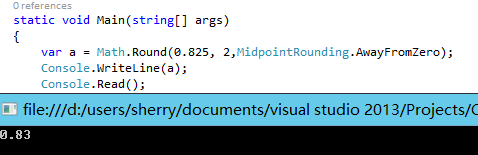
網上有人說 這個API 計算小數時有問題, 其實我們可以自己實現Round 函數,
 public static decimal Round(decimal d, int decimals)
        {
            decimal tenPow = Convert.ToDecimal(Math.Pow(10, decimals));
            decimal scrD = d * tenPow + 0.5m;
            return (Convert.ToDecimal(Math.Floor(Convert.ToDouble(scrD))) / tenPow);
        }
或者如下,
 public static decimal Round(decimal d, int decimals)
        {
            d = d + 0.000000000000001m;
            return Decimal.Round(d, decimals);
        }
如果我們現在需要 用js 來實現 銀行家算法,又該怎麼實現了
  Number.prototype.round = function (len)
        {
            var old = this;
            var a1 = Math.pow(10, len) * old;
            a1 = Math.round(a1);
            var oldstr=old.toString()
            var start = oldstr.indexOf(".");
            if (start > 0 &&  oldstr.split(".")[1].length==len+1)
            {
                if (oldstr.substr(start + len + 1, 1) == 5)
                {
                    var flagval = oldstr.substr(start + len, 1) - 0;
                    if (flagval % 2 == 0)
                    {
                        a1 = a1 - 1;
                    }
                }
            }
            var b1 = a1 / Math.pow(10, len);
            return b1;
        }