數據綁定是一種簡單方式來顯示數據,UI元素與數據對象之間的連接或綁定是允許數據在兩者之間 流動的。另外建立了綁定且數據發生變化時,相應的UI元素會自動顯示變化。
如何將UI元素與 數據進行綁定
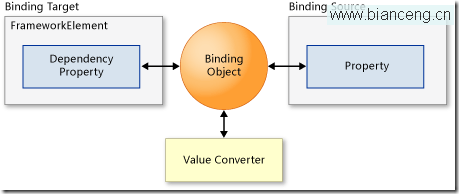
從上面圖可以知道,每個綁定必須指定一個源和一個目標。
其中源對象可以是任何CLR對象,包括目標元素自身和其他UI元素。目標可以是 FrameworkElement的任何DependencyProperty(依賴屬性)。
數據綁定引擎從Binding對象獲取 以下內容:
1)源對象和目標對象;
2)數據流的方向;
3)值轉換器;
例如:使用C#代碼和XAML將TextBox的Foreground屬性進行綁定。
XAML代碼:
<TextBoxx:Name="MyTextBox"Text="Text"Foreground="{Binding Brush1,

Mode=OneWay}"/>
C#代碼:
MyColors textcolor = new MyColors

();
textcolor.Brush1 = new SolidColorBrush

(Colors.Red);
MyTextBox.DataContext = textcolor;
綁定是使用 {Binding…}語法在XAML中創建的。源是通過設置TextBox的DataContent屬性在代碼中設置的。
另外數據是會被繼承的。若我們在某個父元素上設置數據上下文,那麼其子元素將使用同一數據。我們 可以通過設置Binding.Path屬性綁定到源對象的某個屬性。
數據綁定的方向
每一個綁 定都包含一個Mode屬性,用於確定數據流動的方式和時間。
三種類型的綁定:
1) OneTime:綁定會在創建時使用源數據更新目標。
2)OneWay:綁定會在創建時以及數據發生更 改時使用源數據更新目標(默認模式)。
3)TwoWay:綁定會在目標和源中的任一個發生更改時 同時更新目標和源。
數據更改通知
當源數據對象進行了更改,如何將新的源數據對象 傳遞給目標對象呢?解決辦法是源數據對象繼承INotifyPropertyChanged 接口。因為 INotifyPropertyChanged 接口提供了PropertyChanged 事件,該事件會告訴數據綁定引擎,源對象已 經改變,方便更改目標值。
例如:
// Create a class that implements

INotifyPropertyChanged.

public class MyColors : INotifyPropertyChanged

{

    private SolidColorBrush _Brush1;

    // Declare the PropertyChanged event.

    public event PropertyChangedEventHandler PropertyChanged;

    // Create the property that will be the source of the binding.

    public SolidColorBrush Brush1

    {

        get { return _Brush1; }

        set

        {

            _Brush1 = value;

            // Call NotifyPropertyChanged when the source property

            // is updated.

            NotifyPropertyChanged("Brush1");

        }

    }

    // NotifyPropertyChanged will raise the PropertyChanged event,

    // passing the source property that is being updated.

    public void NotifyPropertyChanged(string propertyName)

    {

        if (PropertyChanged != null)

        {

            PropertyChanged(this,

                new PropertyChangedEventArgs(propertyName));

        }

    }

}
示例代碼中MyColors類繼承了INotifyPropertyChanged 接口,當Brush1屬性更改時將觸發 PropertyChanged事件通知目標對象以及更改。
數據轉換
當我們存儲的數據在UI界面顯 示的時候,對用戶來講不友好時,可以將數據進行相應的轉換進行顯示。這時我們就需要一個數據的轉 換器了。
我們可以在任意的綁定上設置轉換器,並且自定義轉換器類必須繼承實現 IValueConverter 接口。
例如:
// Custom class implements the IValueConverter

interface.

public class DateToStringConverter : IValueConverter

{

    #region IValueConverter Members

    // Define the Convert method to change a DateTime object to

    // a month string.

    public object Convert(object value, Type targetType,

        object parameter, string language)

    {

        // value is the data from the source object.

        DateTime thisdate = (DateTime)value;

        int monthnum = thisdate.Month;

        string month;

        switch (monthnum)

        {

            case 1:

                month = "January";

                break;

            case 2:

                month = "February";

                break;

            default:

                month = "Month not found";

                break;

        }

        // Return the value to pass to the target.

        return month;

    }

    // ConvertBack is not implemented for a OneWay binding.

    public object ConvertBack(object value, Type targetType,

        object parameter, string language)

    {

        throw new NotImplementedException();

    }

    #endregion

}
當從源對象傳遞數據時,綁定引擎會調用Convert 並將返回的數據傳遞回目標。
當 從目標傳遞數據時,綁定引擎會調用ConvertBack 並將返回的數據傳遞回源。
XAML代碼中設置 Converter:
<UserControl.Resources>

  <local:DateToStringConverter x:Key="Converter1"/>

</UserControl.Resources>

...

<TextBlock Grid.Column="0"

  Text="{Binding Month, Converter={StaticResource Converter1}}"/>
轉換器中還有 兩個可選參數:ConverterLanguage(該參數允許指定在轉換中使用的語言)和 ConverterParameter( 該參數允許為轉換邏輯傳遞一個參數)。
注意:若在數據轉換中存在錯誤,最好不要拋出異常 ,而是返回DependencyProperty.UnsetValue,它將停止數據傳輸。
支持的綁定方案
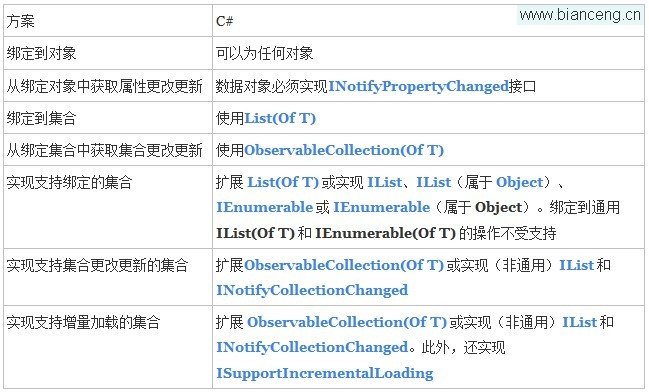
注:該表格根據MSDN提供的文檔進行相應的整理。