As a student of grade two , Math problems are always troubling me . Especially the preparatory examination here ( That is, the two best high schools here recruit students one year in advance , An examination to select top students ) nearly , The math problems I'm facing are getting more and more painful .
see , Trouble is coming. :
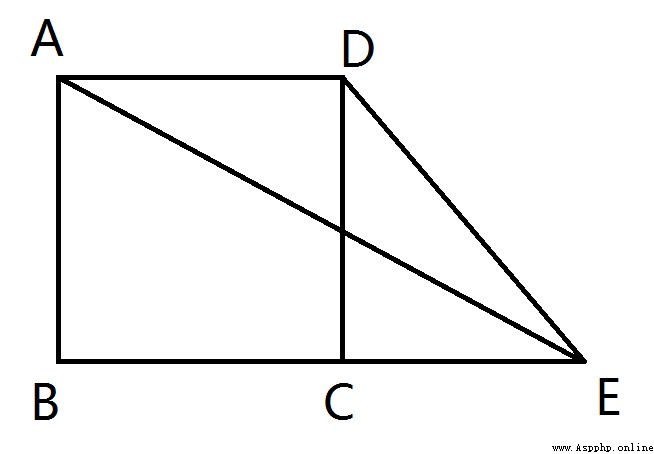
Pictured , In the square ABCD in ,E In the ray BC On , Connect AE、CE, be DE/AE The minimum value of is ________.
Get this question , Confidence slowly I calmly set AB:CE by 1:x, namely AB=k,CE=xk, So the original formula ( Set to y)=[k^2+(xk)^2]^0.5/[k^2+(k+xk)^2]^0.5( there “^” On behalf of the power ). That's all we need [k^2+(xk)^2]/[k^2+(k+xk)^2] The minimum value of ! This is a problem of finding the minimum value of an algebraic formula .
But …… The more you look at it, the more wrong it is . This algebraic expression is a fraction , However, the same type of questions we often contact are only integral forms . With my impression of six junior high school math books , I can't help asking questions : Is this really the content of junior high school ? There seems to be no mention in the book ?
however , In the spirit of hard-working old scalper , I spent hours there with this topic fruitlessly . Final , I gave up .
But maybe it's inspiration from a dream , The next morning , It occurred to me that : Why not pass a Python Program to enumerate one by one , Choose an approximate value from them ?
therefore , The first program came out :
k=1
answer=100
myx=0
for x in range(10):
y=(k**2+(x*k)**2)**0.5/(k**2+(k+x*k)**2)**0.5
if y<answer:
answer=y
myx=x
print(answer,myx)
Output results :
0.6324555320336759 1
alas , The more you look at it, the more something goes wrong ?
Last , I finally found the problem : Traverse like this x, Its values are all integers , In fact, the smallest y The corresponding x It doesn't have to be an integer .
Good. , Let's change :
k=1
answer=100
myx=0
for x in range(10000):
x=x/1000
y=(k**2+(x*k)**2)**0.5/(k**2+(k+x*k)**2)**0.5
if y<answer:
answer=y
myx=x
print(answer,myx)
Output :
0.6180339889095493 0.618
There's no problem with this ? There is still a problem . How can you be sure of x The range of ?
This problem seems fatal , But it's not completely incomprehensible . We can roughly infer that ,y The change trend of should be first down and then up or first up and then down ( This reasoning is instinctive to me , So that I can't explain the process in detail , But it can be concluded by reasoning ), Since it is to find the minimum , Of course, it is the former . therefore , because x from o.618 To 1 Is increasing , therefore x It must be 0.618 Or below , And these numbers obviously we have traversed to ( At least in a certain precision ). Next , All we need is to improve the accuracy , So as to get a result closer to the real value , And use it to guess the right answer .
Final , With high accuracy ( The procedure is roughly the same as before , Just increase the traversal value and x A multiple of reduction , Not listed here ), We get the results :
0.6180339887498948 0.618034
We all know , Before the decimal point of the golden ratio 65 Bit is equal to 0.6180339887498948482045868343656381177203091798057628621354486227, The first few digits of this number are completely consistent with the result of our traversal . We have reason to believe that , The answer is the golden ratio (5^0.5-1)/2. therefore , We use it perfectly Python That solved the problem .
Of course , Later, our teacher explained to us how to solve this problem without procedures : Try to change the unknown part of the formula into x+a/x In the form of , This formula will never be less than 2a^0.5. such , We can get the maximum value .
 The full set of Python tutorials that you spent 3W to buy in the new year are no longer available. Now they are given to people who are destined to be friends. No money
That year 3w Bought a full set