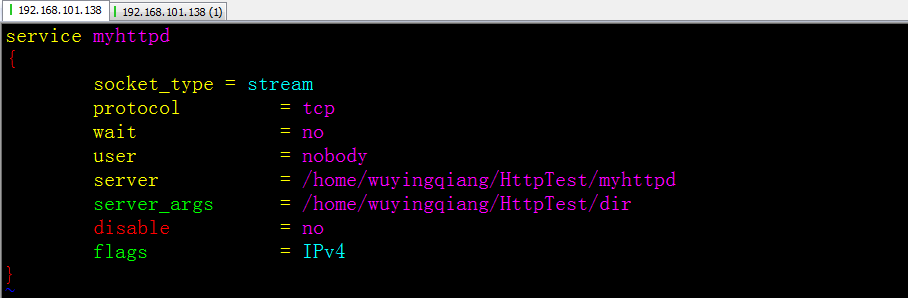
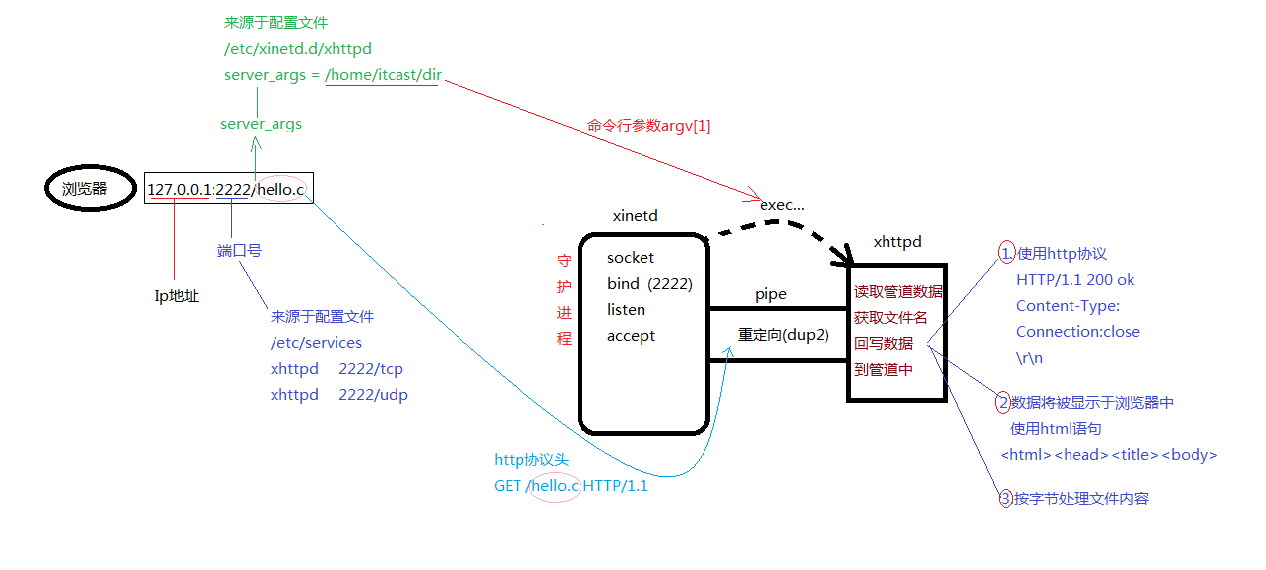
4. 重啟xinetd服務器 sudo service xinetd restart
#include <sys/types.h>
#include <sys/stat.h>
#include <unistd.h>
#include <stdlib.h>
#include <string.h>
#include <dirent.h>
#include <ctype.h>
#include <stdio.h>
#include <time.h>

#define SERVER_NAME "xhttpd"
#define PROTOCOL "HTTP/1.1"
#define SERVER_URL "http://www.itcast.cn/"
#define	FORMAT_DATE "%a, %d %b %Y %H:%M:%S GMT"
#define N 4096

#ifdef DEBUG

#define log(info, str)\
	do{
		fprintf(fp_tmp, "%s%s", info, str);
		fflush(fp_tmp);
	}while(0)

/* put them in the right place.

//fp_tmp = fopen(/home/akaedu/dir/log.text, "a");
//log("argv[1]", argv[1]);
//log("line:", line);

*/
#endif

//設置http協議頭部分
static void send_headers(int status, char *title, char *extra_header, char *mime_type, off_t length, time_t mod);
//返回出錯頁面
static void send_error(int status, char *title, char *extra_header, char *text);
//用於文件名編碼,對應strdecode
static void strencode(char *to, size_t tosize, const char *from);
//輸出文件相關屬性詳細信息
static void file_infos(char *dir, char *name);
//URL解碼
static void strdecode(char *to, char *from);
//通過文件名推斷文件的mime_type
static char *get_mime_type(char *name);
//十六進制轉換為十進制數
static int hexit(char c);

int main(int argc, char **argv)
{
    char line[N*2], method[N*2], path[N*2], protocol[N*2], idx[N*4], location[N*4];
    char *file;
    size_t len;

    int ich, i, n;
    struct stat sb;
    FILE *fp;
    struct dirent **dl;

    if (argc != 2)          //xinetd中的server_args
		send_error(500, "Internal Error", NULL, "Config error - no dir specified.");

	//xinetd啟動時把根路徑(xhttpd服務器文檔的根目錄)傳給本程序,這步非常非常重要
    if (chdir(argv[1]) < 0) //更改工作目錄
		send_error(500, "Internal Error", NULL, "Config error - couldn't chdir.");

    //http協議第一行    如:GET /hello.c HTTP/1.1
    if (fgets(line, sizeof(line), stdin) == NULL)   //提取請求行,包含請求方法/路徑/協議
		send_error(400, "Bad Request", NULL, "No request found.");

    /* "%[^ ] %[^ ] %[^ ]" 將一行字符串按空格切割為三個子串
     應用舉例:
	 GET方法:在浏覽器的地址欄中輸入網址訪問網頁時,浏覽器采用GET方法向服務器獲取資源,
	 eg:GET /form.html HTTP/1.1
	 method   = GET
	 path     = /form.html
	 protocol = HTTP/1.1
	 返回值:成功返回實際讀到的字段個數,失敗返回-1
	*/
    if (sscanf(line, "%[^ ] %[^ ] %[^ ]", method, path, protocol) != 3) //提取方法/路徑/協議
		send_error(400, "Bad Request", NULL, "Can't parse request.");

	//讀到請求頭結束
    while (fgets(line, sizeof(line), stdin) != NULL) {		//注意stdin被dup2至xinetd管道的讀端
		if (strcmp(line, "\n") == 0 || strcmp(line, "\r\n") == 0)
			break;
	}

	//只支持GET請求,strcasecmp,忽略大小寫
    if (strcasecmp(method, "GET") != 0)
		send_error(501, "Not Implemented", NULL, "That method is not implemented.");

	//path必須從‘/’開始。
    if (path[0] != '/')
		send_error(400, "Bad Request", NULL, "Bad filename.");

    file = &(path[1]);		//file = path+1

	//解碼路徑名,搞掉%20之類的東西
    strdecode(file, file);

    if (file[0] == '\0')
		file = "./";

	//檢測是否為合法的文件格式,防止越界訪問到根目錄上級目錄
    len = strlen(file);
    if (file[0] == '/' || strcmp(file, "..") == 0
					   || strncmp(file, "../", 3) == 0
					   || strstr(file, "/../") != NULL
					   || strcmp(&(file[len-3]), "/..") == 0)
	{
		send_error(400, "Bad Request", (char*)0, "Illegal filename.");
	}

    //測試有無請求之文件(或目錄),stat為獲取指定目錄位置文件file函數,sb為傳出參數。
    if (stat(file, &sb) < 0)
		send_error(404, "Not Found", (char*)0, "File not found.");
		/*
		 *404頁面 當用戶輸入了錯誤的鏈接時,返回的頁面,用戶無法解決該錯誤
		 *標准化可配置HTTP協議錯誤,定位在400到505之間
		 *
		 *1、無法在所請求的端口上訪問Web站點
		 *2、Web服務擴展鎖定策略阻止本請求
		 *3、MIME映射測略阻止本請求
		 *
		 */

    //請求路徑是目錄嗎
    if (S_ISDIR(sb.st_mode)) {      //路徑名對應目錄

		if (file[len-1] != '/') {   //路徑名要以"/"結尾
	    	snprintf(location, sizeof(location), "Location: %s/", path);
	    	send_error(302, "Found", location, "Directories must end with a slash.");
	    }
	    //有index.html則處理之
		snprintf(idx, sizeof(idx), "%sindex.html", file);

		if (stat(idx, &sb) >= 0) {
	    	file = idx;
	    	goto do_file;	//如果有index.html則跳到do_file:
	    }

	    //顯示請求目錄下的文件列表
		send_headers(200, "Ok", NULL, "text/html", -1, sb.st_mtime);

		printf("<html><head><title>Index of %s</title></head>"
		               "\n<body bgcolor=\"#99cc99\"><h4>Index of %s</h4>\n<pre>\n"
		               , file, file);
		/*
		 *  int scandir(const char *dirp,
		 *				struct dirent ***namelist,
		 *			    int (*filter)(const struct dirent *),
		 *			    int (*compar)(const struct dirent **, const struct dirent **)
		 *			   );
		 *	依據匹配項目,掃描一個目錄
		 *	掃描dirp目錄下(不包括子目錄)滿足filter過濾模式的文件,
		 *  返回的結果是compare函數經過排序的,並保存在namelist中。
		 *
		 *	scandir() 函數掃描目錄 dirp,對每一個目錄項(文件名)調用filter()。
		 *	把每一個filter() 返回非零項目保存在一個通過malloc(3) 分配的緩存區裡,
		 *	再通過比較函數是compar() 的qsort(3) 函數排序,最後收集在namelist 的數組裡,
		 *	這個數組也是通過malloc(3) 分配的。如果filter 是 NULL,所有項目都被選擇
		 *
		 *  alphasort和versionsort是使用到的兩種排序的函數
		 *
		 *	scandir() 函數返回被選擇的目錄條數,或者如果出錯返回 -1。
		 */
		n = scandir(file, &dl, NULL, alphasort);    //讀取目錄下各個目錄項,並返回每個文件信息.

		if (n < 0)
	    	perror("scandir");
		else
	    	for (i = 0; i < n; ++i)
				file_infos(file, dl[i]->d_name);

		printf("</pre>\n<hr>\n<address><a href=\"%s\">%s</a></address>\n</body></html>\n"
		       , SERVER_URL, SERVER_NAME);

	} else {					//所請求非目錄而是一個文件

do_file:                        //獲取文件內容並返回給客戶端

		fp = fopen(file, "r");	//只讀方式將文件打開
		if (fp == (FILE*)0)
	    	send_error(403, "Forbidden", (char*)0, "File is protected.");

		//發送http協議頭,200表示成功, OK是隨便寫的
		send_headers(200, "Ok", (char*)0, get_mime_type(file), sb.st_size, sb.st_mtime);
		while ((ich = getc(fp)) != EOF)
	    	putchar(ich);
	}

    fflush(stdout);
    exit(0);
}

//輸出文件相關的詳細屬性信息,包括日期和時間
static void file_infos(char *dir, char *name)
{
    static char encoded_name[N];
    static char path[N];
    char timestr[16];
    struct stat sb;

    strencode(encoded_name, sizeof(encoded_name), name);
    snprintf(path, sizeof(path), "%s/%s", dir, name);

    if (lstat(path, &sb) < 0)
        //設置顯示格式,"-"表示左對齊,不加"-"即為右對齊;-32表示顯示內容占32列不足用空格補齊;32s表輸出字符串的32個字符.
		printf("<a href=\"%s\">%-32.32s</a>    ???\n", encoded_name, name);
    else {
		strftime(timestr, sizeof(timestr), "%d%b%Y %H:%M", localtime(&sb.st_mtime));
		printf("<a href=\"%s\">%-32.32s</a>    %15s %14lld\n", encoded_name, name, timestr, (int64_t)sb.st_size);
	}
	/*
	 *size_t strftime(char *s, size_t max, const char *format,
						const struct tm *tm);
	 * 將當前系統的絕對時間,按格式輸出。
	 * format以百分號(%)開始的格式命令集合,格式化輸出結果放在s中。
	 *
	 * %d 十進制表示的日期(01~31)
	 * %b 月份英文單詞的簡寫
	 * %Y 帶世紀部分的十進制年份
	 * %H 24小時制的小時
	 * %M 十進制表示的分鐘數(00~59)
	 */
}

/*
 *出錯時,發送錯誤相應信息,返回出錯頁面
 *
 *status:錯誤號  title:錯誤名  text:錯誤描述
 *extra_header:附加描述(特殊情況302時不退出程序,而直接顯示正常頁面)
 */
static void send_error(int status, char* title, char* extra_header, char* text)
{
    send_headers(status, title, extra_header, "text/html", -1, -1);
    printf("<html><head><title>%d %s</title></head>\n<body bgcolor=\"#cc9999\"><h4>%d %s</h4>\n",
			status, title, status, title);

    printf("%s\n", text);
    printf("<hr>\n<address><a href=\"%s\">%s</a></address>\n</body></html>\n", SERVER_URL, SERVER_NAME);
    fflush(stdout);

    exit( 1 );
}

/*
 *每個HTTP傳送都包含一個首部、一個空行和要發送的數據項。
 *Content-Type:		數據項的類型(必選項)
 *Content-length:	數據項的大小
 *Content-Encoding:	數據項使用的編碼方式
 *Content-Language:	數據項使用的語言
 *
 *首部中的每一行都包含一個關鍵字、一個冒號和信息。
 *e.g.
 *Content-Type: text/html; charset=iso-8859-1		指明屬性的首部
 *Content-Length: 508
 *													這是一行空行
 *<html> 文檔內容 </html>							數據項
 */

static void
send_headers(int status, char* title, char* extra_header, char* mime_type, off_t length, time_t mod)
{
    time_t now;
    char timebuf[100];

    printf("%s %d %s\r\n", PROTOCOL, status, title);//HTTP/1.0 200 OK
    printf("Server: %s\r\n", SERVER_NAME);//Server: xhttpd
    now = time((time_t*)0);
    strftime(timebuf, sizeof(timebuf), FORMAT_DATE, gmtime(&now));
    printf("Date: %s\r\n", timebuf);
	// Date: Fri, 18 Jul 2014 14:34:26 GMT

    if (extra_header != NULL)
		printf("%s\r\n", extra_header);

    if (mime_type != NULL)
		printf("Content-Type: %s\r\n", mime_type);

    if (length >= 0)
		printf("Content-Length: %lld\r\n", (int64_t)length);

    if (mod != (time_t)-1) {	//強轉
		strftime(timebuf, sizeof(timebuf), FORMAT_DATE, gmtime(&mod));
		printf("Last-Modified: %s\r\n", timebuf);
	}
	printf("Connection: close\r\n");
	printf("\r\n");
}

static char *get_mime_type(char *name)
{
    char* dot;

    dot = strrchr(name, '.');	//自右向左查找‘.’字符;如不存在返回NULL

	/*
	 *charset=iso-8859-1	西歐的編碼,說明網站采用的編碼是英文;
	 *charset=gb2312		說明網站采用的編碼是簡體中文;
	 *charset=utf-8			代表世界通用的語言編碼;
     *						可以用到中文、韓文、日文等世界上所有語言編碼上
	 *charset=euc-kr		說明網站采用的編碼是韓文;
	 *charset=big5			說明網站采用的編碼是繁體中文;
	 *
	 *以下是依據傳遞進來的文件名,使用後綴判斷是何種文件類型
	 *將對應的文件類型按照http定義的關鍵字發送回去
	 */
    if (dot == (char*)0)
		return "text/plain; charset=iso-8859-1";
    if (strcmp(dot, ".html") == 0 || strcmp(dot, ".htm") == 0)
		return "text/html; charset=iso-8859-1";
    if (strcmp(dot, ".jpg") == 0 || strcmp(dot, ".jpeg") == 0)
		return "image/jpeg";
    if (strcmp(dot, ".gif") == 0)
		return "image/gif";
    if (strcmp(dot, ".png") == 0)
		return "image/png";
    if (strcmp(dot, ".css") == 0)
		return "text/css";
    if (strcmp(dot, ".au") == 0)
		return "audio/basic";
    if (strcmp( dot, ".wav") == 0)
		return "audio/wav";
    if (strcmp(dot, ".avi") == 0)
		return "video/x-msvideo";
    if (strcmp(dot, ".mov") == 0 || strcmp(dot, ".qt") == 0)
		return "video/quicktime";
    if (strcmp(dot, ".mpeg") == 0 || strcmp(dot, ".mpe") == 0)
		return "video/mpeg";
    if (strcmp(dot, ".vrml") == 0 || strcmp(dot, ".wrl") == 0)
		return "model/vrml";
    if (strcmp(dot, ".midi") == 0 || strcmp(dot, ".mid") == 0)
		return "audio/midi";
    if (strcmp(dot, ".mp3") == 0)
		return "audio/mpeg";
    if (strcmp(dot, ".ogg") == 0)
		return "application/ogg";
    if (strcmp(dot, ".pac") == 0)
		return "application/x-ns-proxy-autoconfig";

	return "text/plain; charset=iso-8859-1";
}

/*
 * 處理URL中%20之類的東西!是"解碼"過程。
 * %20 URL編碼中的‘ ’(space)
 * %21 '!' %22 '"' %23 '#' %24 '$'
 * %25 '%' %26 '&' %27 ''' %28 '('......
 *
 * 相關知識html中的‘ ’(space)是
 */
static void strdecode(char *to, char *from)
{
    for ( ; *from != '\0'; ++to, ++from) {

		if (from[0] == '%' && isxdigit(from[1]) && isxdigit(from[2])) {

	    	*to = hexit(from[1])*16 + hexit(from[2]);
	    	from += 2;//移過已經處理的兩個字符(%21指針指向1),表達式3的++from還會再向後移一個字符
	    } else
	    	*to = *from;
	}
    *to = '\0';
}

//16進制數轉化為10進制, return 0不會出現
static int hexit(char c)
{
    if (c >= '0' && c <= '9')
		return c - '0';
    if (c >= 'a' && c <= 'f')
		return c - 'a' + 10;
    if (c >= 'A' && c <= 'F')
		return c - 'A' + 10;

    return 0;
}

//"編碼",用作回寫浏覽器的時候,將除字母數字及/_.-~以外的字符轉義後回寫。
//strencode(encoded_name, sizeof(encoded_name), name);
static void strencode(char* to, size_t tosize, const char* from)
{
    int tolen;

    for (tolen = 0; *from != '\0' && tolen + 4 < tosize; ++from) {
		if (isalnum(*from) || strchr("/_.-~", *from) != (char*)0) {
			*to = *from;
			++to;
			++tolen;
		} else {
			sprintf(to, "%%%02x", (int) *from & 0xff);
			to += 3;
			tolen += 3;
		}
	}
    *to = '\0';
}