相關基礎概念請從其它教材簡單了解,這裡僅記錄下第一個Hibernate程序的實現步驟。
環境說明:
java開發工具:eclipse MARS.2 Release(4.5.2)
hibernate版本:hibernate-release-4.3.6.Final
Web 容器:Tomcat v8.0
數據庫:MySQL 5.6.19-enterprise-commercial-advanced
jdbc驅動:mysql-connector-java-commercial-5.1.30-bin.jar
1.下載hibernate。
2.下載jdbc驅動文件。
3.在eclipse中新建web project,命名為firsthibernate。
4.拷貝hibernate/lib/required文件夾下的所有jar文件、以及jdbc驅動文件(此文件另外下載)到項目的WEB-INF/lib文件夾下,拷貝hibernate/project/etc下的hibernate.cfg.xml文件到項目的src目錄下。
5.新建實體類Cat,Hibernate中配置實體類有兩種方法:XML文件配置和@注解配置,本例采用@注解配置,相關注解代表的含義在代碼中都有注明如下:
package com.levice.firsthibernate.bean;

import java.util.Date;
import javax.persistence.Column;
import javax.persistence.Entity;
import javax.persistence.GeneratedValue;
import javax.persistence.GenerationType;
import javax.persistence.Id;
import javax.persistence.JoinColumn;
import javax.persistence.ManyToOne;
import javax.persistence.Table;
import javax.persistence.Temporal;
import javax.persistence.TemporalType;

@Entity                              //注解Entity表示該類能被Hibernate持久化
@Table(name = "tb_cat")              //指定該Entity對應的數據表名
public class Cat {

    @Id                              //指定該列為主鍵。主鍵類型最好不要使用int等原始類型
    @GeneratedValue(strategy = GenerationType.AUTO) //主鍵類型auto表示該主鍵為自增長型
    private Integer id;

    @Column(name = "name")           //指定該屬性對應的數據庫表的列為name,列名與屬性名一樣時這句注解可省略
    private String name;

    @Column(name = "description")
    private String description;

    @ManyToOne                       //指定實體類之間的關系,本例表示多對一關系
    @JoinColumn(name = "mother_id")
    private Cat mother;

    @Temporal(TemporalType.TIMESTAMP)//日期類型(DATE,TIME或TIMESTEMP)
    @Column(name = "birthday")
    private Date birthday;


    //getters and setters
    public Integer getId() {
        return id;
    }
    public void setId(Integer id) {
        this.id = id;
    }
    public String getName() {
        return name;
    }
    public void setName(String name) {
        this.name = name;
    }
    public String getDescription() {
        return description;
    }
    public void setDescription(String description) {
        this.description = description;
    }
    public Cat getMother() {
        return mother;
    }
    public void setMother(Cat mother) {
        this.mother = mother;
    }
    public Date getBirthday() {
        return birthday;
    }
    public void setBirthday(Date birthday) {
        this.birthday = birthday;
    }
}
6.修改配置文件hibernate.cfg.xml,內容及注釋如下:
<!DOCTYPE hibernate-configuration PUBLIC
    "-//Hibernate/Hibernate Configuration DTD 3.0//EN"
    "http://www.hibernate.org/dtd/hibernate-configuration-3.0.dtd">

<hibernate-configuration>
    <session-factory>
        <!-- 配置JDBC -->
        <property name="connection.driver_class">com.mysql.jdbc.Driver</property>
        <property name="connection.url">jdbc:mysql://localhost:3306/hibernate</property>
        <property name="connection.username">root</property>
        <property name="connection.password">123456</property>

        <!-- 指定使用MySQL數據庫格式的SQL語句 -->
        <property name="dialect">org.hibernate.dialect.MySQLDialect</property>

        <!-- 指定在控制台打印生成的SQL語句 -->
        <property name="show_sql">true</property>

        <!-- 指定Hibernate啟動時自動創建表結構 -->
        <property name="hbm2ddl.auto">create</property>

        <!-- 加上這一句以防止未知錯誤 -->
        <property name="current_session_context_class">thread</property>

        <!-- 指定Cat類為Hibernate實體類 -->
        <mapping class="com.levice.firsthibernate.bean.Cat"/>
    </session-factory>
</hibernate-configuration>
7.初始化數據庫,在MySQL中創建數據庫hibernate,SQL代碼如下:
create database hibernate;
8.配置HibernateUtil,就是修改HibernateUtil.java文件,這個文件在下載的hibernate文件中有,但我Copy過來的時候,一直沒調試成功,於是采用了一個版本比較老的HibernateUtil。這個文件的作用是獲取SessionFactory從而獲取Session,不同版本的hiberate中獲取SessionFactory的方法都不同,這裡可以新建一個HibernateUtil.java文件,然後把下面的代碼copy進去。
package com.levice.firsthibernate.util;

import org.hibernate.SessionFactory;
import org.hibernate.cfg.AnnotationConfiguration;

@SuppressWarnings("deprecation")
public class HibernateUtil {

    private static final SessionFactory sessionFactory;
    static{
        try{
            sessionFactory = new AnnotationConfiguration().configure().buildSessionFactory();
        }catch(Throwable ex){
            System.err.println("Initial SessionFactory creation failed.");
            throw new ExceptionInInitializerError(ex);
        }
    }

    public static SessionFactory getSessionFactory(){
        return sessionFactory;
    }
}
9.執行Hibernate程序,創建一個包含主函數main的類CatTest,代碼及注釋如下:
package com.levice.firsthibernate.test;

import java.awt.Font;
import java.util.Date;
import java.util.List;
import javax.swing.JOptionPane;
import org.hibernate.Session;
import org.hibernate.Transaction;
import com.levice.firsthibernate.bean.Cat;
import com.levice.firsthibernate.util.HibernateUtil;

public class CatTest {

    public static void main(String[] args) {
        // TODO Auto-generated method stub

        /*初始化幾只Cat的信息*/
        Cat mother = new Cat();
        mother.setName("Mother White");
        mother.setDescription("This is mother cat");
        mother.setBirthday(new Date());

        Cat kitty = new Cat();
        kitty.setMother(mother);
        kitty.setName("Kitty");
        kitty.setDescription("This is Kitty");
        kitty.setBirthday(new Date());

        Cat tom = new Cat();
        tom.setMother(mother);
        tom.setName("Tom");
        tom.setDescription("This is Tom");
        tom.setBirthday(new Date());

        @SuppressWarnings("static-access")
        Session session = new HibernateUtil().getSessionFactory().openSession(); //獲取session並open,開啟一個Hibernate會話
        Transaction trans = session.beginTransaction(); //開啟一個事務

        session.persist(mother); //將mother保存到數據庫
        session.persist(kitty);
        session.persist(tom);

        @SuppressWarnings("all")
        List<Cat> catList = session.createQuery(" from Cat ").list(); //查詢數據庫中所有的貓
        StringBuffer result = new StringBuffer();
        result.append("all cats: \r\n\r\n");
        for (Cat cc : catList) {
            result.append("name:" + cc.getName() + "\n");
            result.append("mother:" + (cc.getMother() == null ? "null" : cc.getMother().getName()) + "\n");
            result.append("description:" + cc.getDescription() + "\r\n\r\n");
        }

        trans.commit(); //提交事務
        session.close(); //關閉Hibernate會話

        //用Swing顯示查詢結果
        JOptionPane.getRootFrame().setFont(new Font("Arial", Font.BOLD, 14));
        JOptionPane.showMessageDialog(null, result.toString());

    }

}
10.運行CatTest,可以看到如下輸出:
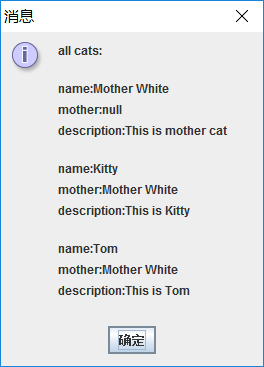
控制台輸出的SQL語句如下:
Hibernate: alter table tb_cat drop foreign key FK_dix3h50rxo8ahrcu5roir75n1
Hibernate: drop table if exists tb_cat
Hibernate: create table tb_cat (id integer not null auto_increment, birthday datetime, description varchar(255), name varchar(255), mother_id integer, primary key (id))
Hibernate: alter table tb_cat add constraint FK_dix3h50rxo8ahrcu5roir75n1 foreign key (mother_id) references tb_cat (id)
Hibernate: insert into tb_cat (birthday, description, mother_id, name) values (?, ?, ?, ?)
Hibernate: insert into tb_cat (birthday, description, mother_id, name) values (?, ?, ?, ?)
Hibernate: insert into tb_cat (birthday, description, mother_id, name) values (?, ?, ?, ?)
Hibernate: select cat0_.id as id1_0_, cat0_.birthday as birthday2_0_, cat0_.description as descript3_0_, cat0_.mother_id as mother_i5_0_, cat0_.name as name4_0_ from tb_cat cat0_