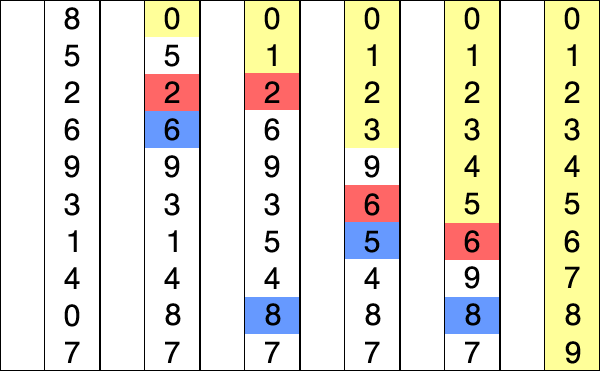
Red is current min. Yellow is sorted list. Blue is current item. (picture from wikipedia, a little too fast)
10 numbers. Sort as ascend.
1. Find the min of the 10 and switch it with a[0], requires 9 times of compare
2. Find the min of the rest 9 and switch it with a[1], requires 8 times of compare
. . .
1, 10, 9
2, 9, 8
3, 8, 7
4, 7, 6
5, 6, 5
6, 5, 4
7, 4, 3
8, 3, 2
9, 2, 1
In conclusion: For 10 numbers, we need 9 times of finding the min, each has one-short amount of numbers to compare.
Implementation in PHP:
 1 <?php
 2 /* selection sort:
 3     1. operate directly on the input array (&), not on a copy
 4     2. sort as ascend
 5
 6     a is array
 7     m is length of a
 8     n is times of outer loop, which is finding min of the rest
 9     i/j is for-loop counter
10     w is for value swap
11     min is min
12     sub is index of array
13 */
14 function sortSelection(&$a){
15     $m = count($a);
16     $n = $m - 1;
17     $min;
18     $sub;
19     for($i=0; $i<$n; $i++){
20         $min = $a[$i];
21         for($j=$i; $j<$m; $j++){
22             if($a[$j] < $min){
23                 $min = $a[$j];
24                 $sub = $j;
25             }
26             else{
27                 $sub = $i;
28             }
29         }
30         $a[$sub] = $a[$i];
31         $a[$i] = $min;
32         // echo implode(', ', $a).'<br />';
33     }
34 }
35
36 $arr = array(9, 5, 2, 7, 3);
37 sortSelection($arr);
38 echo implode(', ', $arr);
39
40 // 2, 3, 5, 7, 9
41 ?>
void selection_sort(int array[],int k)
{
int i,j,m,t;
for(i=0;i<k;i++){//做第i趟排序(1≤i≤n-1)
m=i;
for(j=i+1;j<=k;j++)
if(array[j]<array[m])
m=j; //k記下目前找到的最小值所在的位置
if(m!=i){
t=array[i];
array[i]=array[m];
array[m]=t;
}
}
}
void main(){
int a[10];
for (int i=0;i<10;i++)
scanf("%d",&a[i]);
selection_sort(a,10);
printf("排序結果為:");
for (i=0;i<10;i++)
printf("%d\n",a[i]);
}
void selection_sort(int array[],int k)
{
int i,j,m,t;
for(i=0;i<k;i++){//做第i趟排序(1≤i≤n-1)
m=i;
for(j=i+1;j<=k;j++)
if(array[j]<array[m])
m=j; //k記下目前找到的最小值所在的位置
if(m!=i){
t=array[i];
array[i]=array[m];
array[m]=t;
}
}
}
void main(){
int a[10];
for (int i=0;i<10;i++)
scanf("%d",&a[i]);
selection_sort(a,10);
printf("排序結果為:");
for (i=0;i<10;i++)
printf("%d\n",a[i]);
}