Series column :【python Learning notes 】

today Python The content of the notes is :
once Python An exception occurred in the script , The program needs to catch and handle exceptions .
Exception handling enables the program to continue normal execution after handling exceptions , So as not to crash or terminate the execution .
When Python An exception occurs when the program cannot be processed properly . Exception is Python object , A mistake .
When Python We need to catch and deal with the exception of the script , Otherwise, the program will terminate
for instance :
>>> a = int(input())
x
Traceback (most recent call last):
File "<stdin>", line 1, in <module>
ValueError: invalid literal for int() with base 10: 'x'
In the above code ,ValueError Is an exception , By exception information , We can find the wrong line number .
In the previous example , The revised code is :
>>> while True:
try:
a = int(input(" Please enter an integer :"))
print(" The number you entered is :",a)
break
except ValueError:
print(" You are not entering an integer !")
Please enter an integer :3.14
You are not entering an integer !
Please enter an integer :a
You are not entering an integer !
Please enter an integer :6
The number you entered is : 6
In the above procedure :
try and except;int() function Will throw out ValueError abnormal ;try block Detected in ValueError abnormal when , It will end try Block subsequent code ;except block Code for ;except ValueError: After the code is executed , The program will continue from while sentence Continue with the beginning of ;int() function Will throw out ValueError abnormal , that try: After break sentence They don't execute , The program will cycle all the time ;int() function It won't throw out ValueError abnormal ,try block Can continue to execute , Until I met break sentence , The program will exit the loop ;try And except Statement is used to detect try Exception in statement block , And let except Statement to catch and handle exceptions ; If you don't want the program to be forced to end after an exception occurs , It needs to be in try Sentence block Exception caught in , And in except Sentence block Exception handling in .
try And except Can be used as follows :
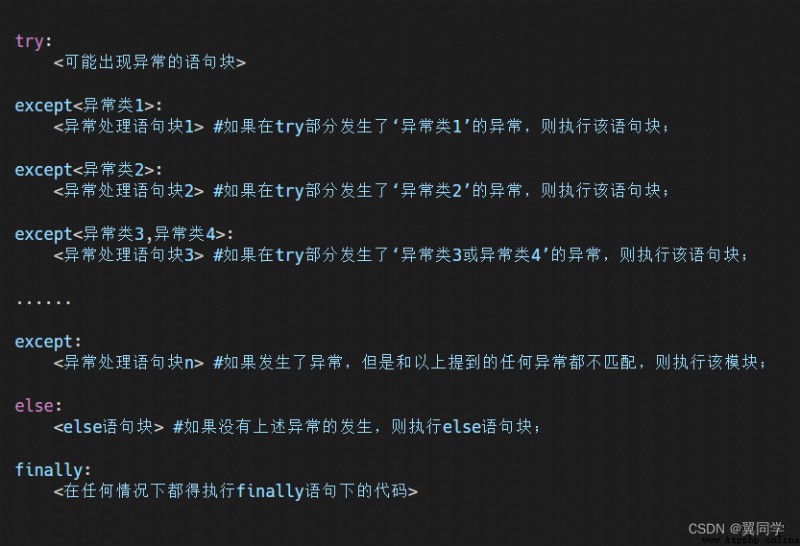
The analysis is as follows :
tryStatement blocks in execute first .- If
tryIn statement block An exception occurred during the execution of a statement ,PythonJust jump toexceptpart , Judge from top to bottom Whether the exception object thrown is related toexceptThe following exception classes match , And execute the first... That matches the exceptionexceptStatement block after , Exception handling completed .- If something goes wrong , But no matching exception category was found , Execute... Without any matching type
exceptStatement block after statement , Exception handling completed .- If
tryAn exception occurred in one of the statements in the statement block , There is no matchexceptClause , There is no one without a matching typeexceptpart , The exception will be submitted to the upper layertry/exceptStatement for exception handling , Or until the exception is passed to the top layer of the program , This ends the program .- If
tryNo exception occurs when any statement in the statement block is executed ,PythonWill performelseStatement block after statement .- After execution
exceptAfter the exception handling statement orelseAfter the following statement block , The program must executefinallyStatement block after . The statement block here is mainly used for closing operations , Whether or not an exception occurs, it will be executed .- An exception handling module has at least one
tryAnd aexceptSentence block ,elseandfinallyStatement blocks are optional .
Look at a piece of code :
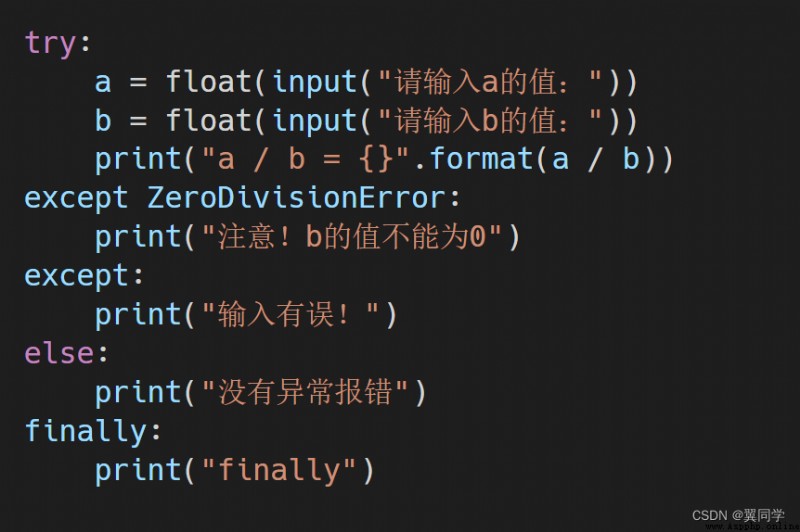
The three tests are as follows :
1) Enter... In the correct format , be except None of the following modules will execute ,else The resulting module will be executed ,finally The following module statements will execute .
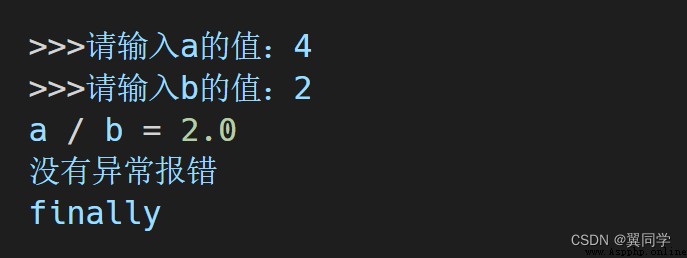
0, Will be detected ZeroDivisionError Exception object , stay except ZeroDivisionError: Later modules will be executed to handle the exception . After exception handling , perform finally Statement block after .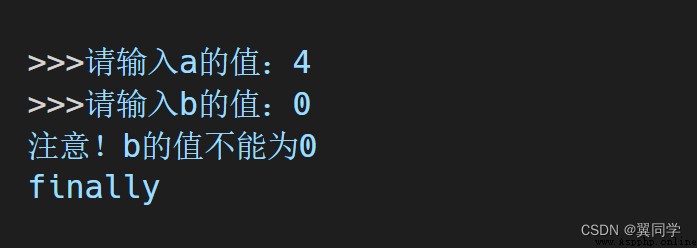
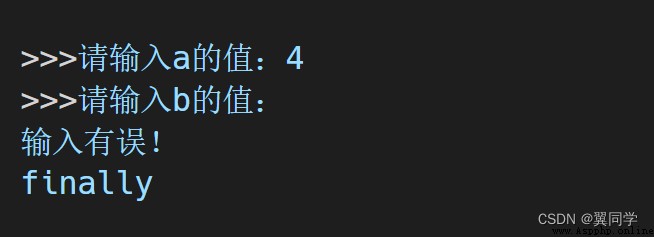
3) If you just type a Value ,b No assignment , be try The module will throw TypeError abnormal . In program exception handling except The handler module for this type of exception is not listed in , Without exception type except The module can intercept the exception and handle it . After exception handling ,finally The following statements will also be executed .
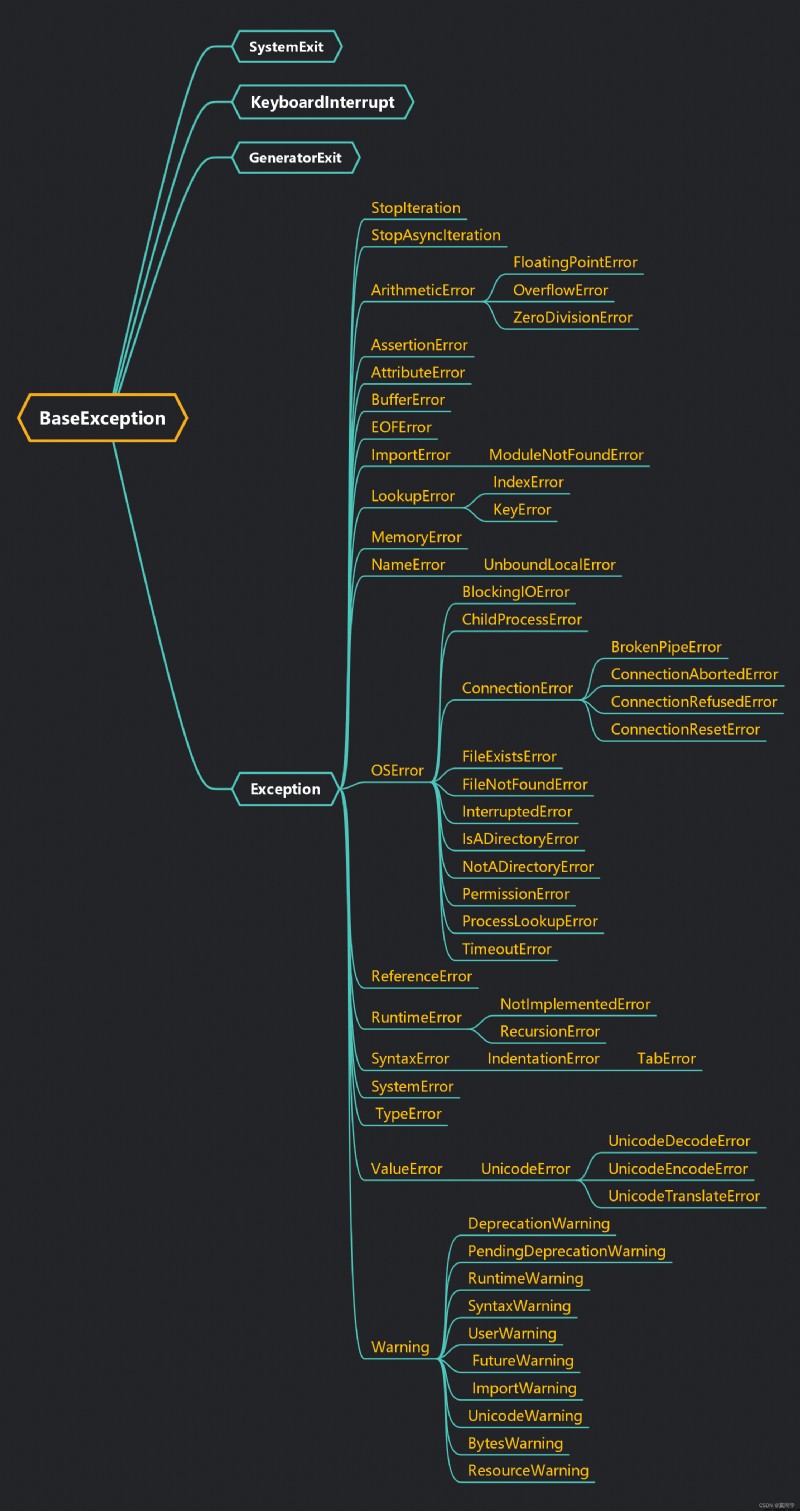
BaseException The base class for all exceptions SystemExit The interpreter requests exit KeyboardInterrupt User interrupt execution ( Usually the input ^C)GeneratorExit generator (generator) An exception occurs to notify the exit Exception Regular error base class StopIteration Iterators have no more values StandardError All built-in standard exception base classes ArithmeticError Base class for all numerical errors FloatingPointError Floating point error OverflowError The numerical operation exceeds the maximum limit ZeroDivisionError except ( Or modulus ) zero ( All data types )AssertionError Assertion statement failed AttributeError Object does not have this property EOFError No built-in input , arrive EOF Mark EnvironmentError Base class for operating system errors IOError Input / Output operation failed OSError Operating system error WindowsError System call failed ImportError The import module / Object failed LookupError Base class for invalid data query IndexError There is no index in the sequence (index)KeyError There is no key in the map MemoryError Memory overflow error ( about Python The interpreter is not fatal )NameError Not a statement / Initialize object ( There is no attribute )UnboundLocalError Accessing an uninitialized local variable ReferenceError Weak reference (Weak reference) Trying to access a garbage collected object RuntimeError General runtime errors NotImplementedError A method that has not yet been implemented SyntaxErrorPython Grammar mistakes IndentationError The indentation error TabErrorTab Mixed with Spaces SystemError General interpreter system error TypeError Invalid operation on type ValueError Invalid parameter passed in UnicodeErrorUnicode Related errors UnicodeDecodeErrorUnicode Error in decoding UnicodeEncodeErrorUnicode Error in coding UnicodeTranslateErrorUnicode Error in conversion Warning The base class for warnings DeprecationWarning A warning about abandoned features FutureWarning A warning about future semantic changes in construction OverflowWarning Old about auto promotion to long form (long) Warning of PendingDeprecationWarning A warning that features will be discarded RuntimeWarning Suspicious runtime behavior (runtime behavior) Warning of SyntaxWarning A dubious grammatical warning UserWarning Warnings generated by user code The general structure of the exception class is as follows :
Okay , Today's notes are here , Welcome to the comment area to discuss .